Greener Journal of Journalism, Advertisement and Mass Communication
Vol. 1(1), pp. 17-27, December, 2025
Copyright ©2025, Creative Commons Attribution 4.0 International.
Journal DOI: 10.15580/gjjamc
Journal website: https://gjjamc.gjournals.org

|
Greener Journal of Journalism, Advertisement and Mass Communication Vol. 1(1), pp. 17-27, December, 2025 Copyright ©2025, Creative Commons Attribution 4.0 International. Journal DOI: 10.15580/gjjamc Journal website: https://gjjamc.gjournals.org |
|
City FM Radio and Stakeholder Engagement in School Development Projects in Dar es Salaam City Council, Tanzania
Neema Dauseni1; Rev. Dr. Joseph Matumaini2
1Senior Information Officer, Dar es salaam City Council, Tanzania. Email: dawsonney@gmail.com
2Academician, Department of Journalism and Mass Communication, St. Augustine University of Tanzania
Email: matumaini2010@hotmail.com
|
ABSTRACT |
|||
|
Radio remains one of the most accessible and influential communication tools for mobilizing communities in Sub-Saharan Africa. This study examined the role of City FM Radio, particularly the Asubuhi ya Jiji and Jioni ya Jiji programs, in promoting stakeholder engagement in school development projects within Dar es Salaam City Council. A mixed-methods research design was employed, drawing data from teachers, students, parents, school administrators, education officers, and City FM media practitioners. The findings showed that although City FM provides valuable educational content, program coverage remained limited, with only 33.3% of teachers and 16.7% of students regularly listening to the broadcasts. Stakeholders described the programs as moderately useful, emphasizing clarity and professionalism while noting limited analytical depth and minimal interactivity. Despite these limitations, the programs positively influenced public participation, as 60% of teachers and 70% of students indicated that the broadcasts encouraged community involvement in school meetings, resource mobilization, and project oversight. The study concludes that City FM Radio holds significant potential to enhance public awareness and mobilize communities toward school development; however, this potential remains underutilized due to inconsistent programming, weak outreach, and content gaps. The study recommends strengthening depth, consistency, and audience engagement strategies to maximize the role of radio in educational development. |
|||
|
ARTICLE’S INFO |
|||
|
Article No.: 121725197 Type: Research Full Text: PDF, PHP, HTML, EPUB, MP3 DOI: 10.15580/gjjamc.2025.1.121725197
Received: 20/08/2025 Accepted: 28/11/2025 Published: 29/12/2025
Keywords: City FM Radio, Asubuhi ya Jiji and Jioni ya Jiji programs, Stakeholder Engagement, School Development Projects, Dar es Salaam City Council
|
*Corresponding Author
Neema Dauseni
E-mail: bapropsk@gmail.com |
Article’s QR code
|
|
|
|
|
|
|
1. INTRODUCTION
Radio remains one of the most influential and enduring mass communication media in Africa, particularly in contexts where access to digital technologies and print media is limited. Its wide reach, affordability, and ability to transcend literacy barriers have positioned radio as a critical tool for public education, civic engagement, and development communication (Myers, 2020; UNESCO, 2014; African Development Bank [AfDB], 2018). Scholars of communication for development emphasize that radio’s participatory potential—especially through interactive talk shows, call-ins, and public discussions—makes it uniquely suited to mobilizing communities and facilitating stakeholder engagement in development initiatives (Dagron, 2001; Manyozo, 2012; Tufte, 2017).
In the education sector, stakeholder engagement is increasingly recognized as a cornerstone of effective and sustainable school development projects. Participation by parents, teachers, students, community leaders, civil society organizations, and government authorities enhances accountability, local ownership, and responsiveness to contextual needs (Freire, 1970; Banda & Moyo, 2022). Media, particularly radio, plays a crucial role in shaping public awareness and influencing participation by setting agendas, framing issues, and highlighting development priorities (McCombs & Shaw, 1972; Entman, 1993; Scheufele & Tewksbury, 2007). Agenda-setting and framing theories explain how repeated coverage of education issues can elevate public concern, shape perceptions of school development challenges, and motivate collective action among stakeholders (Ball-Rokeach & DeFleur, 1976; Chong & Druckman, 2007; Druckman, 2001).
Globally and within Africa, empirical studies demonstrate that educational radio programs have been effective in promoting learning continuity, civic awareness, and community participation. Community and public radio stations have been widely used to support distance education, parental involvement, and dialogue on school governance, especially during periods of crisis such as the COVID-19 pandemic (Buckler & Perraton, 2020; UNESCO, 2020; World Bank, 2021). Evidence from countries such as Kenya, Uganda, Senegal, Ghana, and Malawi indicates that radio programs focusing on education not only disseminate information but also stimulate discussion and mobilize communities to support school development initiatives (Mendy & Ba, 2016; Osei et al., 2017; Kivuva, 2021; Lumu, 2022; Mpagazehe, 2015).
In Tanzania, radio continues to be a dominant and trusted medium for development communication and public dialogue. Studies highlight its role in promoting education, addressing social inequalities, and encouraging civic participation at both national and community levels (Lwoga, 2010; Mbilinyi, 2018; Mlama, 2021; Mpehongwa, 2020). Educational and advocacy-oriented radio programs have contributed to parental engagement, awareness of school development challenges, and broader discussions on education policy and governance (Chibambo, 2016; Komba, 2020; Ndumbaro, 2023). Initiatives supported by institutions such as the Tanzania Institute of Education further underscore the relevance of radio in supplementing formal education and fostering community involvement, particularly in underserved areas (TIE, 2022; MoEST, 2021).
Within Dar es Salaam City Council, rapid urbanization has intensified challenges related to school infrastructure, overcrowding, and limited resources, thereby increasing the need for effective stakeholder engagement in school development projects (Komba & Mwandanji, 2019; MoEST, 2023). Local media outlets, especially urban radio stations, have become important platforms for highlighting these challenges and facilitating dialogue between communities and authorities (Berger, 2009; Dar es Salaam Media Observatory, 2022). City FM Radio, through its popular programs Asubuhi ya Jiji and Jioni ya Jiji, has established itself as a forum for public discussion on social and development issues, including education, governance, and community welfare (Mfumbusa, 2018; Habari Maelezo, 2020; DCC, 2018).
Despite the growing recognition of radio’s role in development communication, there remains a limited empirical understanding of how specific radio programs contribute to stakeholder engagement in school development projects at the local government level. Existing studies often focus broadly on media and education, with less attention given to program-level analysis and audience participation dynamics (Achieng, 2022; Nabirye, 2023). This study therefore seeks to evaluate the role of City FM Radio’s Asubuhi ya Jiji and Jioni ya Jiji programs in promoting stakeholder engagement in school development projects within Dar es Salaam City Council. By examining the nature of program content, stakeholder participation, and perceived impact, the study contributes to development communication scholarship and offers insights for media practitioners, educators, and policymakers on leveraging radio as a tool for inclusive and participatory educational development.
Statement of the Problem
Despite persistent challenges confronting school development projects in Dar es Salaam City Council, stakeholder participation remains relatively limited. One of the key obstacles is inadequate public awareness and understanding of ongoing and planned school development initiatives. Although radio has been widely recognized as an effective medium for raising awareness and mobilizing communities-particularly in urban settings with high listenership-its actual influence on stakeholder engagement in school development remains insufficiently examined. City FM Radio, through its programs Asubuhi ya Jiji and Jioni ya Jiji, purports to promote public participation by providing platforms for dialogue on education and community development issues. However, there is limited empirical evidence to ascertain whether these programs are accessible to diverse stakeholders, relevant to school development concerns, or effective in motivating meaningful community involvement. The absence of such evidence constrains policymakers, educators, and media practitioners in their efforts to strategically utilize radio as a tool for enhancing stakeholder engagement in school development projects. This study therefore seeks to address this gap by systematically evaluating the relevance, reach, and influence of City FM Radio in fostering stakeholder participation in school development initiatives within Dar es Salaam City Council.
Study Objectives
(i) To assess the coverage of City FM Radio’s Asubuhi ya Jiji and Jioni ya Jiji Program in relation to school development projects in Dar es Salaam City.
(ii) To evaluate the quality of City FM Radio’s Asubuhi ya Jiji and Jioni ya Jiji Program in raising stakeholders’ awareness about school development projects in Dar es Salaam City.
(iii) To examine the effectiveness of City FM Radio’s Program Asubuhi ya Jiji and Jioni ya Jiji on public participation in school development projects in Dar es Salaam City.
2. LITERATURE REVIEW
Radio continues to occupy a central position in development communication across Africa due to its accessibility, affordability, and cultural embeddedness within local communities. Contemporary scholarship consistently positions radio as a participatory medium capable of promoting dialogue, inclusion, and community engagement, particularly where digital inequalities persist (Banda & Moyo, 2022; Myers, 2020). Unlike internet-based platforms, radio operates within familiar linguistic and social contexts, enabling marginalized populations to access information and participate in discussions that affect their everyday lives (Dagron, 2001; Manyozo, 2012). Its interactive features, including call-ins, SMS, and WhatsApp feedback channels, facilitate dialogic communication that fosters community ownership of development initiatives, including those related to education (Muchunu & Wekesa, 2021).
Theoretical perspectives grounded in participatory communication and communication for social change emphasize dialogue, collective reflection, and local problem-solving as essential elements for sustainable development (Freire, 1970; Mefalopulos, 2008; Tufte, 2017). Within this framework, radio’s influence extends beyond information dissemination to the facilitation of shared understanding and coordinated action. Scholars argue that radio is most effective when audiences perceive it as a trusted social actor rather than a detached broadcaster, a perception that enhances credibility and motivates engagement in public issues (McAnany, 2012; Wanyama, 2020). These theoretical insights remain highly relevant in urban African settings where media convergence is increasing but does not replace the need for inclusive and low-cost communication platforms.
Empirical studies across East Africa between 2020 and 2025 affirm radio’s continued contribution to civic engagement and education-related participation. Research from Kenya demonstrates that community radio improves parental understanding of school governance by providing localized information on budgeting, teacher allocation, and administrative processes (Kivuva, 2021). Similar evidence from Uganda indicates that sustained radio dialogue enhances parental involvement in school construction and monitoring of development projects by creating consistent spaces for public discussion and accountability (Nakatudde, 2022; Nabirye, 2023). These findings align with media effects research suggesting that participation is most likely when media content supports deliberation rather than one-directional messaging (Scheufele & Tewksbury, 2007).
In Tanzania, radio remains the most widely consumed and trusted medium, maintaining its centrality despite rapid changes in the media environment. National surveys indicate that a significant majority of citizens rely on radio as their primary source of civic and development information (Tanzania Media Foundation, 2021). Studies conducted in the post-COVID period underscore radio’s ability to deliver localized and credible information, particularly in addressing education and community development needs (Mhando & Msuya, 2023; Mlama, 2021). Nevertheless, much of the Tanzanian literature has focused on health communication and policy dissemination, offering limited analysis of radio’s role in mobilizing stakeholders around school development projects, especially in urban contexts.
Empirical evidence further reveals that the frequency and consistency of radio programming significantly influence its developmental outcomes. Comparative studies across Kenya, Ghana, and Tanzania show that while radio stations regularly address social and development issues, education-related content constitutes a relatively small share of airtime and is often episodic rather than sustained (Opoku & Tuwei, 2021). Similar patterns are reported in Uganda, where coverage of school development initiatives frequently lacks continuity and systematic follow-up, limiting community oversight and long-term engagement (Lumu, 2022). Tanzanian content reviews echo these trends, highlighting intermittent coverage of school development that peaks during crises but declines once immediate attention subsides (Media Council of Tanzania, 2022; TEN/MET, 2023).
Beyond airtime allocation, the impact of radio on stakeholder engagement is strongly shaped by the quality and depth of information provided. Development communication scholars argue that shallow reporting may raise awareness but seldom leads to sustained action or accountability (Mutegeki, 2021; Reese, 2001). Empirical studies from Kenya, Nigeria, and Uganda reveal that education-related radio broadcasts often lack investigative depth, diverse stakeholder perspectives, and follow-up reporting, thereby limiting their capacity to support informed community participation (Achieng, 2022; Nabirye, 2023). Tanzanian research similarly observes that education programs frequently omit voices of parents, school committees, and local officials, resulting in incomplete coverage of school development challenges and processes (Mpehongwa & Kanyoma, 2021; Ndumbaro, 2023).
The influence of radio on public awareness and engagement is further explained through agenda-setting and framing theories, which continue to inform contemporary media effects research. Repeated and in-depth coverage elevates the salience of education issues and shapes public understanding of responsibility and potential solutions (McCombs & Shaw, 1972; Entman, 1993; Scheufele & Tewksbury, 2007). Empirical evidence from South Africa and Kenya supports this theoretical position, showing that well-structured radio programs significantly increase civic participation when they emphasize transparency, follow-up, and inclusive dialogue (Mulanga, 2021; Mwangi, 2024). In Tanzania, recent studies report higher levels of community participation in school meetings, resource mobilization, and project oversight in areas where radio consistently highlights school development needs and encourages public dialogue (TEN/MET, 2023; Mhando & Lema, 2022).
Despite this growing body of theoretical and empirical literature, a significant gap remains in understanding the role of urban radio stations in promoting stakeholder engagement in school development projects in Tanzania. Existing studies rarely examine program-level dynamics such as reach, consistency, and content depth within urban media markets. Notably, no published empirical research has systematically assessed the contribution of City FM Radio in Dar es Salaam, despite its sizable listenership and frequent engagement with social issues. As a result, it remains unclear whether City FM’s programming effectively raises awareness, mobilizes resources, or strengthens stakeholder participation in school development initiatives. This study addresses this gap by empirically examining the relevance, reach, and influence of City FM Radio in fostering community engagement in school development projects within Dar es Salaam City Council.
3. METHODOLOGY
This study used a mixed-methods research design combining qualitative and quantitative techniques. The research was conducted in Dar es Salaam City Council across four administrative zones: Ilala, Segerea, Ukonga, and Kivule. The target population included teachers, students, parents, school leaders, education officials, and City FM Radio practitioners. A total of 113 participants were selected using purposive and random sampling. Data collection tools included semi-structured interviews, questionnaires, and content analysis of the Asubuhi ya Jiji and Jioni ya Jiji programs. Quantitative data were analyzed using descriptive statistics, while qualitative data underwent thematic analysis. Ethical procedures were followed, including informed consent, confidentiality, and voluntary participation.
This section presents the findings based on the three specific objectives of the study: (i) To assess the coverage of City FM Radio’s Asubuhi ya Jiji and Jioni ya Jiji Program in relation to school development projects in Dar es Salaam City; (ii) To evaluate the quality of City FM Radio’s Asubuhi ya Jiji and Jioni ya Jiji Program in raising stakeholders’ awareness about school development projects in Dar es Salaam City; and (iii) To examine the effectiveness of City FM Radio’s Program Asubuhi ya Jiji and Jioni ya Jiji on public participation in school development projects in Dar es Salaam City.
The coverage of City FM Radio’s Asubuhi ya Jiji and Jioni ya Jiji Program in relation to school development projects in Dar es Salaam City.
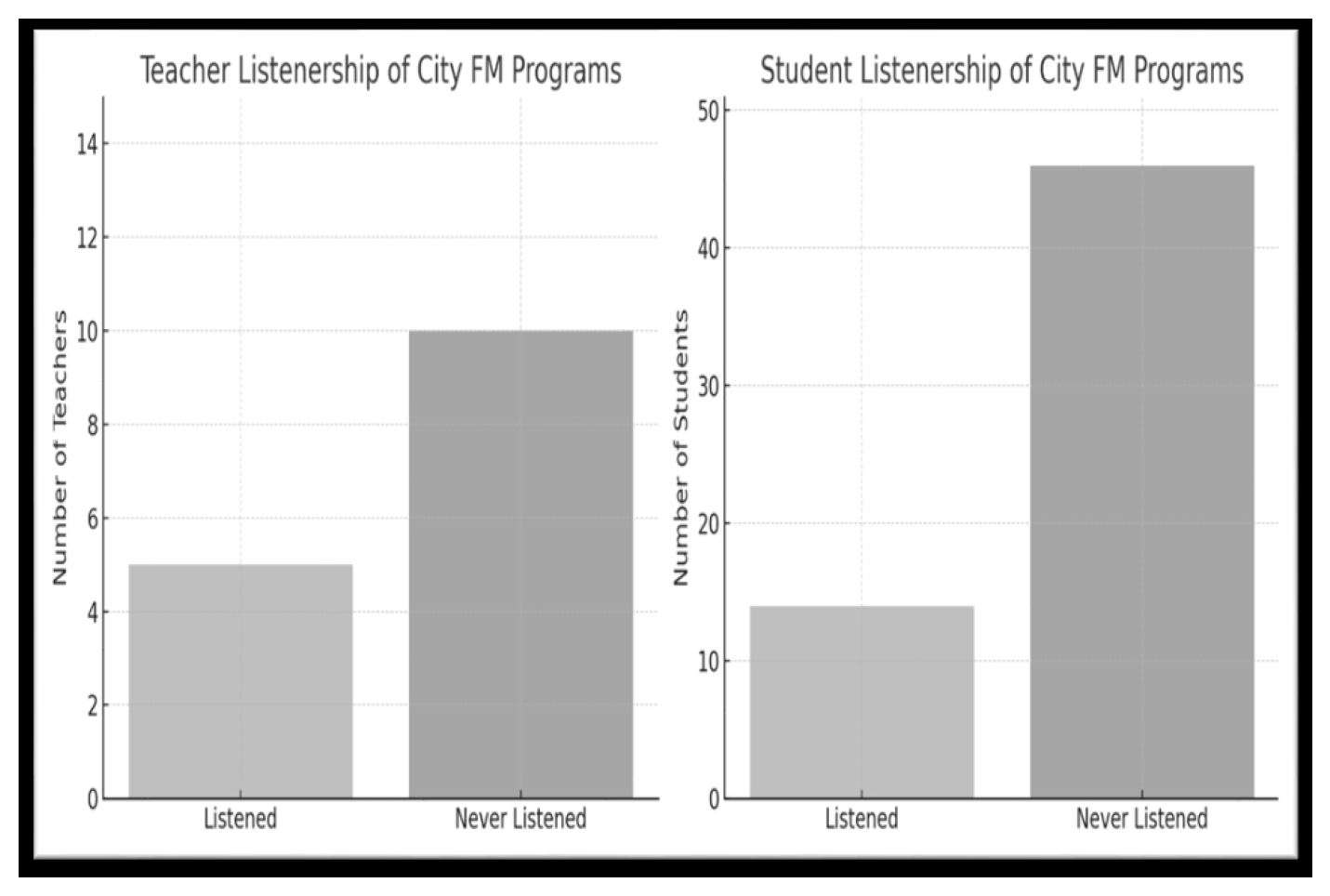
The first specific objective of the study sought to assess the coverage of City FM’s programs, Asubuhi ya Jiji and Jioni ya Jiji, in relation to school development projects. The table below provides the findings for the first specific objective of the study.
Figure 1 Coverage of City FM Radio’s Asubuhi ya Jiji and Jioni ya Jiji Programs
The first objective of this study was to assess the coverage of City FM’s programs Asubuhi ya Jiji and Jioni ya Jiji in relation to school development projects. Radio programs have the potential to inform and engage various stakeholders, including teachers, students, and community members, in initiatives that improve school infrastructure, learning resources, and overall academic performance. However, the effectiveness of such programs largely depends on their accessibility and the degree to which the target audience listens and engages with the content. Radio programs have the potential to inform and engage various stakeholders, including teachers, students, and community members, in initiatives that improve school infrastructure, learning resources, and overall academic performance in Segerea, Kivule, Ukonga, and Ilala. However, the effectiveness of such programs largely depends on their accessibility and the degree to which the target audience listens and engages with the content.
The quality of City FM Radio’s Asubuhi ya Jiji and Jioni ya Jiji Program in raising stakeholders’ awareness about school development projects in Dar es Salaam City.
The second specific objective of the study aimed at evaluating the quality of City FM Radio’s Asubuhi ya Jiji and Jioni ya Jiji Program in raising stakeholders’ awareness about school development projects in Dar es Salaam City. The findings for this specific objective two are presented in short form in the table below.
Table 1: Quality of City FM Radio’s Asubuhi ya Jiji and Jioni ya Jiji Programs (N = 15)
|
Aspect |
Frequency (n) |
Percentage (%) |
Remarks |
|
Excellent |
2 |
13.3% |
A few teachers rated the programs as highly informative and well-presented |
|
Good |
2 |
13.3% |
Some teachers expressed moderate satisfaction |
|
Average |
10 |
66.7% |
Majority felt the programs were acceptable but not exceptional |
|
Poor/Very Poor |
1 |
6.7% |
Very few teachers reported dissatisfaction |
|
Total |
15 |
100% |
|
The second objective of this study aimed to assess the quality of City FM’s educational programs Asubuhi ya Jiji and Jioni ya Jiji particularly in relation to school development and education-related content. Findings from the 15 participating teachers showed that the programs were rated moderately overall.
The results revealed that two-thirds of the teachers (66.7%) rated the program quality as Average, indicating that although the programs were generally acceptable, they lacked depth, stronger relevance, or more engaging presentation styles. A small proportion of teachers, 13.3%, rated the programs as Good, showing moderate satisfaction with specific components of the content. Another 13.3% rated the programs as Excellent, suggesting that a few teachers perceived the programs as highly informative and professionally delivered. Meanwhile, 6.7% of teachers rated the programs as Poor or Very Poor, reflecting that very few respondents were dissatisfied with the clarity, relevance, or overall presentation of the programs.
Overall, the results suggest that City FM’s educational programs are functional but require improvement, especially in enriching content depth, enhancing audience engagement, and ensuring clearer, more consistent delivery.
Table 2: Students’ Perception of City FM Educational Programs (N = 60)
|
Aspect |
Frequency (n) |
Percentage (%) |
Remarks |
|
Students Who Perceived Educational/School Development Topics |
|
|
|
|
Yes |
30 |
50.0% |
Half of the students recognized school-related topics in the programs |
|
No |
20 |
33.3% |
Did not perceive any educational content |
|
Not Sure |
10 |
16.7% |
Could not remember or were uncertain about the content
|
Table 2 presents the perceptions of sixty students regarding the presence and relevance of educational content in City FM’s programs. The findings indicate that students’ awareness of education-related discussions on the radio was moderate and unevenly distributed across the sample. Exactly half of the students, representing fifty percent of the respondents, acknowledged that City FM addressed topics related to education and school development. This suggests that the programs were reasonably successful in reaching a significant segment of the student audience, providing them with information on issues that affect the school environment and the broader educational context. The presence of this level of recognition implies that the programs were somewhat effective in communicating educational messages, though evidently not to the level where they reached the entire student population.
Despite this moderate level of awareness, a substantial proportion of the students did not identify educational content in the programs. One-third of the respondents, equivalent to thirty-three point three percent, reported that they had not encountered any discussions related to school development or education within the broadcasts. This finding may indicate limitations in students’ exposure to the programs, possibly because some do not listen frequently, do not focus on educational segments, or prefer other types of content presented by the station. Additionally, a further sixteen-point seven percent of students were unsure whether such topics were included in the programs. The fact that this group could not clearly recall what they had listened to suggests either a lack of engagement with the programs or a presentation style that did not make educational content particularly memorable or distinguishable from entertainment segments.
When the analysis turns to specific topics that students were able to recall, the results reflect an even more limited level of retention. Only a very small number of students could mention particular school-related issues discussed by City FM. For instance, three students, representing five percent of the sample, remembered hearing about school buildings. Another two students, making up three-point three percent, recalled discussions concerning teachers’ needs, while only one student, equivalent to one point seven percent, remembered content related to learning materials. These numbers demonstrate that even among those who listened to the programs, only a handful retained concrete details about the educational topics covered. This low level of topic-specific recall suggests that the educational segments may not be sufficiently engaging or detailed to remain in the minds of the student audience. It may also indicate that the educational content is overshadowed by other aspects of the programming such as music, news, or entertainment features.
The data reflect a pattern in which City FM’s educational programs reach students to a moderate extent but fail to leave a strong or lasting impression for most of them. While half of the students recognized the existence of educational content, very few were able to recall specific topics, pointing to a gap between exposure and retention. This implies that although the station includes educational material within its programming, improvements are needed in the depth, clarity, and presentation of this content in order to make it more engaging, memorable, and meaningful for young listeners. Strengthening these aspects could enhance students’ understanding of school-related issues and potentially increase the educational impact of the programs.
Effectiveness of City FM Radio’s Asubuhi ya Jiji and Jioni ya Jiji Program on public participation in school development projects in Dar es Salaam City.
Table 3: Effectiveness of City FM Programs on Teachers’ Stakeholder Involvement (N = 15)
|
Question |
Response |
Frequency (n) |
Percentage (%) |
|
1. Did City FM motivate you to engage in school development activities? |
Yes |
9 |
60.0% |
|
|
No/Not Sure |
6 |
40.0% |
|
Total for Question 1 |
|
15 |
100% |
|
2. Did you observe increased stakeholder engagement as a result of City FM programs? |
Yes |
10 |
66.7% |
|
|
No |
5 |
33.3% |
|
Total for Question 2 |
|
15 |
100% |
Table 3 presents findings from fifteen teachers who were asked two related questions to assess the effectiveness of City FM Radio’s Asubuhi ya Jiji and Jioni ya Jiji programs in promoting stakeholder participation in school development projects in Dar es Salaam City. The first question explored whether the radio programs motivated teachers themselves to engage in school development activities. Out of the total respondents, nine teachers, representing sixty percent, agreed that the programs encouraged them to take part in school improvement efforts. This suggests that the content broadcast through City FM has the potential to influence teachers’ attitudes by raising awareness, stimulating interest, and strengthening their commitment to school development initiatives. However, six teachers, accounting for forty percent, indicated that the programs did not motivate them or that they were unsure. This mixed response implies that the motivational influence of the programs may vary depending on personal listening habits, the perceived relevance of the topics discussed, or differences in school environments across the respondents.
The second question sought to determine whether teachers had observed any actual increase in stakeholder participation such as involvement from parents, community members, and fellow teachers following the broadcast of City FM’s educational programs. The results show that ten teachers, equivalent to sixty-six-point seven percent, noticed an increase in engagement within their school communities. This indicates that City FM may play an important role in mobilizing wider groups to participate in school development projects, possibly by disseminating information, raising awareness of needs, or encouraging collective responsibility for educational improvement. On the other hand, five teachers, representing thirty-three-point three percent, reported that they did not observe any change in stakeholder involvement. This difference in perception suggests that while the programs may be effective in some contexts, their impact may not be equally felt across all schools due to variations in community dynamics, communication structures, or the extent to which listeners engage with the content.
Generally, the combined results demonstrate that City FM’s educational programs have a meaningful but not uniform influence on both teacher motivation and broader stakeholder participation. While most teachers reported positive effects, the presence of differing views highlights the need for the radio programs to continue enhancing the clarity, consistency, and relevance of their educational content in order to strengthen their impact across diverse school settings.
Table 4: Students’ Perception of City FM’s Influence on Community Support for Schools (N = 60)
|
Aspect |
Response |
Frequency (n) |
Percentage (%) |
Remarks |
|
Community Encouragement to Support Schools |
Agree |
42 |
70% |
Majority believe City FM motivates community support |
|
|
Disagree |
10 |
15.7% |
Some students did not perceive any influence |
|
|
Not Sure |
8 |
13.3% |
Uncertain or unclear about the programs’ impact |
|
Influence on Families |
Parents/Guardians Discussed School Issues |
2 |
1.7% |
Indicates indirect influence on family discussions and engagement |
|
Total |
|
100 |
|
|
Among students in Segerea, Kivule, and Ilala, the findings indicate that City FM’s programs had a significant influence on their perceptions of community involvement in school development. A majority of 42 students (70%) believed that the radio programs encouraged communities to actively support schools, highlighting the role of media in fostering civic awareness and collective responsibility. This suggests that the broadcasts not only reach students directly but also help instill a sense of the importance of school improvement and participation in education-related initiatives. On the other hand, 10 students (16.7%) disagreed, indicating that some learners either did not perceive any tangible impact or were less attentive to the programs’ content. An additional 8 students (13.3%) were unsure, which may reflect limited exposure to the programs, difficulty in recalling specific messages, or the general nature of some broadcasts that may not have directly addressed community engagement.
5. DISCUSSION
The findings of this study demonstrate that City FM Radio’s programs Asubuhi ya Jiji and Jioni ya Jiji play a meaningful but uneven role in promoting stakeholder engagement in school development projects within Dar es Salaam City Council. Overall, the results largely corroborate existing theoretical and empirical literature, while also revealing important limitations that align with earlier concerns about frequency, depth, and consistency of radio-based development communication.
With regard to program coverage, the study found that City FM addresses school development issues across several urban wards, suggesting a reasonable geographic reach and alignment with the station’s mandate as an urban broadcaster. However, stakeholders’ engagement with the content appeared moderate rather than extensive. This finding is consistent with regional studies indicating that although radio stations frequently discuss community development issues, education-related content often occupies a relatively small and inconsistent portion of airtime (Opoku & Tuwei, 2021; Media Council of Tanzania, 2022). The moderate level of exposure observed in this study supports arguments by Lumu (2022) and TEN/MET (2023) that episodic rather than sustained coverage limits radio’s ability to anchor school development as a continuous public agenda. From an agenda-setting perspective, the limited consistency of education-related broadcasts may reduce the salience of school development projects among listeners, thereby constraining broader community engagement (McCombs & Shaw, 1972).
In assessing program quality, the predominance of “average” ratings by teachers suggests that City FM’s educational content is functional but lacks sufficient depth, relevance, and analytical rigor. This finding strongly aligns with earlier studies in Tanzania and the wider region which show that education-focused radio programs often raise awareness without providing adequate contextualization, follow-up, or stakeholder diversity (Achieng, 2022; Mpehongwa & Kanyoma, 2021; Nabirye, 2023). The limited proportion of respondents who rated the programs as excellent further reinforces critiques by Mutegeki (2021) that shallow development reporting, while informative, is insufficient for sustaining accountability or motivating long-term civic action. The results therefore support participatory communication theory, which emphasizes that meaningful engagement requires dialogic, inclusive, and context-rich communication rather than one-directional information flow (Freire, 1970; Tufte, 2017).
Students’ perceptions further illuminate the gap between exposure and impact. Although half of the student respondents recognized education-related content in City FM’s programs, only a very small number could recall specific school development topics. This mirrors findings by Ndumbaro (2023) and Achieng (2022), who argue that when educational content is embedded within broader entertainment-driven programming, it may fail to leave a lasting cognitive imprint. From a framing perspective, the lack of memorable or clearly framed educational narratives may limit the ability of radio programs to shape how young audiences understand school development challenges and assign responsibility for addressing them (Entman, 1993; Scheufele & Tewksbury, 2007). The findings suggest that while City FM reaches students to some extent, the framing and presentation of educational content may not be sufficiently strong to promote sustained awareness or learning.
Despite these limitations, the study found notable evidence that City FM’s programs positively influence stakeholder participation, particularly among teachers and community members. A majority of teachers reported feeling motivated to engage in school development activities and observed increased participation from parents and community members. These results align with empirical evidence from Kenya, Uganda, and Tanzania showing that radio can mobilize stakeholders when it highlights collective responsibility and provides platforms for public dialogue (Kivuva, 2021; Nakatudde, 2022; TEN/MET, 2023). Similarly, students’ perceptions that City FM encouraged community support for schools reinforce arguments that radio can function as a catalyst for civic awareness even when direct informational recall is limited (Mulanga, 2021; Mwangi, 2024).
However, the mixed responses-both among teachers and students underscore that the impact of radio is not uniform across contexts. As suggested by participatory communication scholars, media influence depends heavily on perceived relevance, trust, and opportunities for interaction (Banda & Moyo, 2022; McAnany, 2012). Variations in listening habits, community cohesion, and local leadership structures may explain why some schools experienced increased engagement while others did not. This finding supports earlier assertions that radio’s effectiveness is maximized when programming is sustained, dialogic, and closely aligned with local realities (Dagron, 2001; Mhando & Msuya, 2023).
Overall, the findings confirm the theoretical premise that radio has the capacity to promote stakeholder engagement in school development but also validate empirical concerns raised in the literature regarding inconsistent coverage, moderate content quality, and limited depth. City FM’s Asubuhi ya Jiji and Jioni ya Jiji programs demonstrate potential as platforms for community mobilization; however, their current structure appears more effective in raising general awareness than in fostering deep understanding or sustained participation. These results extend existing literature by providing urban, program-specific evidence from Dar es Salaam, thereby addressing a previously underexplored context. They also suggest that strengthening program consistency, depth of analysis, and stakeholder inclusion could significantly enhance the role of urban radio in supporting school development initiatives.
6. CONCLUSION AND RECOMMENDATIONS
The findings of this study confirm that City FM Radio, through Asubuhi ya Jiji and Jioni ya Jiji, contributes to raising awareness and stimulating stakeholder participation in school development projects within Dar es Salaam City. The programs reach a wide audience and provide a platform through which educational issues are discussed, reinforcing the continued relevance of radio as a development communication tool in urban Tanzania. Teachers and students acknowledged that the programs expose communities to school-related challenges and encourage public interest in education, supporting theoretical and empirical literature that positions radio as an accessible medium capable of promoting civic engagement and collective responsibility.
At the same time, the study reveals that the impact of City FM’s programs is moderate and uneven. Coverage of school development issues is not sufficiently frequent or sustained, and the depth and clarity of the content limit audience retention and engagement, particularly among students. Most teachers rated program quality as average, while many students struggled to recall specific educational topics, indicating that educational messages are often overshadowed by other programming priorities. These findings reflect concerns raised in the literature that episodic and surface-level reporting on education weakens the capacity of radio to translate awareness into sustained participation and accountability.
Based on these findings, the study recommends that City FM Radio strengthen the consistency, depth, and focus of school development content within its programming. Educational segments should be clearly structured, regularly scheduled, and supported by follow-up discussions that track progress and outcomes of school projects. Greater inclusion of teachers, parents, education officials, and students in program discussions would enhance relevance and credibility while promoting participatory dialogue. Collaboration between radio stations and education authorities is also essential to ensure accurate information and sustained community mobilization, enabling radio to serve not only as a source of awareness but as an effective catalyst for long-term stakeholder engagement in school development projects.
REFERENCES
Achieng, P. (2022). Education reporting and media depth in Kenyan community radio. Journal of African Media Studies, 14(3), 211–229.
African Development Bank (AfDB). (2018). The Role of Media in Development. Oxford University Pres
Alumuku, P. (2006). Community Radio for Development: The Role of the Church in Africa. Gregorian University Press.
Ball-Rokeach, S. J., & DeFleur, M. L. (1976). A dependency model of mass-media effectivenesss. Communication Research, 3(1), 3–21.
Banda, F., & Moyo, L. (2022). Participatory communication and media in Africa. Routledge.
BBC Media Action. (n.d.). Niambie: Engaging Tanzania’s Youth Through Radio. https://www.bbcmediaaction.org
Berger, G. (2009). Beyond broadcasting: The future of state-owned broadcasters in Southern Africa. Friedrich-Ebert-Stiftung.
Buckler, A., & Perraton, H. (2020). Education on air: Broadcasting, open distance learning and social change in Africa. Commonwealth of Learning.
Chibambo, M. (2016). The role of radio in promoting education: Evidence from Tanzania. Journal of African Media Studies, 8(2), 175–188.
Chong, D., & Druckman, J. N. (2007). Framing theory. Annual Review of Political Science, 10, 103–126. https://doi.org/10.1146/annurev.polisci.10.072805.103054
Dagron, A. G. (2001). Making waves: Stories of participatory communication for social change. Rockefeller Foundation.
Dar es Salaam City Council (DCC), Database. (2018). Profile of City FM Radio and its Development Initiatives. Dar es Salaam City Council Records.
Dar es Salaam Media Observatory. (2022). Urban radio programming analysis report.
Druckman, J. N. (2001). The implications of framing effectivenesss for citizen competence. Political Behavior, 23(3), 225–256. https://doi.org/10.1023/A:1015006907312
Entman, R. M. (1993). Framing: Toward clarification of a fractured paradigm. Journal of Communication, 43(4), 51–58.
Entman, R. M. (1993). Framing: Toward clarification of a fractured paradigm. Journal of Communication, 43(4), 51–58. https://doi.org/10.1111/j.1460-2466.1993.tb01304.x
Fraser, C., & Restrepo-Estrada, S. (2001). Community Radio Handbook. UNESCO.
Freire, P. (1970). Pedagogy of the Oppressed. Continuum.
Habari Maelezo Profile. (2020). City FM Radio: Voice for Development and Civic Engagement in Tanzania. Government Communication Office.
HakiElimu. (2021). Annual Report on Advocacy for Girls' Education and Community Engagement. HakiElimu Publications.
Iyengar, S. (1990). Shortcuts to political knowledge: The role of selective attention and accessibility. In J. A. Ferejohn & J. H. Kuklinski (Eds.), Information and democratic processes (pp. 160–185). University of Illinois Press.
Iyengar, S. (Updated 2021 edition). Media effects and public responsibility. Cambridge University Press.
Kapinga, O. (2020). The effectivenessiveness of media programs in promoting health awareness in Tanzania. Tanzanian Journal of Community Development, 6(1), 45–57.
Kapinga, R. (2020). Media and social mobilization in Tanzania. African Communication Research, 10(2), 34–51.
Kiousis, S. (2004). Explicating media salience: A factor analysis of New York Times issue coverage during the 2000 U.S. presidential election. Journal of Communication, 54(1), 71–87.
Kivuva, M. (2021). Community radio and parental participation in school governance in Kenya. Eastern Africa Social Science Review, 37(1), 67–85.
Komba, A. (2020). Radio and Parental Engagement in Dodoma. Tanzania Journal of Community Development. DUP
Komba, W. L., & Mwandanji, M. (2019). The Status of Secondary School Infrastructure in Dar es Salaam, Tanzania. Journal of Educational Administration and Policy Studies, 11(3), 20–30.
Kumar, K. (2019). The Role of Radio in Education: A Review of Global Practices. Journal of Educational Media and Technology, 14(2), 45–59.
Lumu, D. (2022). Radio and community engagement in Uganda’s education sector. Journal of Development Communication, 33(1), 55–73.
Lwoga, E. T. (2010). Bridging the information gap in rural Tanzania: The role of rural radio. The Electronic Journal of Information Systems in Developing Countries, 42(1), 1–15.
Manyozo, L. (2012). Media, communication and development: Three approaches. SAGE Publications.
Matumaini, J. (2009). Research on National Communication Policy in Africa and Tanzania. University of KwaZulu-Natal.
Mazur, A., & Lee, J. (2016). Science and public opinion. Minerva, 54(3), 379–404.
Mbilinyi, M. (2018). The role of radio in raising awareness and promoting education in Tanzania. Journal of Education and Development, 2(3), 88–99.
McAnany, E. G. (2012). Saving the World: A Brief History of Communication for Development and Social Change. University of Illinois Press.
McCombs, M., & Ghanem, S. (2001). The convergence of agenda setting and framing. In S. D. Reese, O. H. Gandy, & A. E. Grant (Eds.), Framing public life: Perspectives on media and our understanding of the social world (pp. 67–81). Lawrence Erlbaum Associates.
McCombs, M., & Shaw, D. L. (1972). The Agenda-Setting Function of Mass Media. Public Opinion Quarterly. Chicago University
Media Council of Tanzania (MCT). (2022). Annual Media Performance and Content Review.
Mefalopulos, P. (2008). Development communication sourcebook: Broadening the boundaries of communication. World Bank Publications.
Mendy, P., & Ba, I. (2016). The role of community radio in education development in Senegal. African Communication Research, 9(1), 67–85.
Mfumbusa, B. (2018). Media and Social Change in Tanzania: The Case of City FM Radio. Journal of African Media Studies, 10(2), 147–160.
Mhando, L., & Msuya, R. (2023). Trust in Tanzanian media and public engagement during the post-COVID period. Tanzania Journal of Communication, 9(1), 1–15.
Ministry of Education, Science and Technology (MoEST). (2017). Education Sector Development Plan (2016/17-2020/21).
Ministry of Education, Science and Technology (MoEST). (2021). Education Sector Performance Report.
Ministry of Education, Science and Technology (MoEST). (2021). Report on Implementation Challenges of School Development Projects in Tanzania. Government of Tanzania.
Ministry of Education, Science and Technology (MoEST). (2023). Education Sector Review Report.
Mlama, P. (2021). Community Radio and Lifelong Learning in Tanzania. Adult Education Review, 33(1), 29–38.
Mpagazehe, J. (2015). Radio, Civic Engagement, and Education in Malawi. African Communication Research. Vol.22-45-2015 - Follow APA (7th ed.).
Mpehongwa, G. (2020). Community radio as a development communication tool in Tanzania. African Journal of Development Studies, 10(2), 203–216.
Muchunu, E., & Wekesa, P. (2021). Radio as a facilitator of community dialogue in East Africa. Communication for Development Journal, 6(2), 45–59.
Mutegeki, S. (2021). Media quality and development communication in Africa. Kampala: Makerere University Press.
Mwambene, P. (2024). Radio programming and community participation in school development in Tanzania. Journal of Education and Society, 12(1), 77–98.
Mwangi, J. (2024). Media campaigns and community action in Kenyan educational development. African Journal of Education Studies, 18(1), 89–104.
Myers, M. (2008). Radio and development in Africa: A concept paper. International Development Research Centre (IDRC).
Myers, M. (2020). Radio and development in Africa: A concept paper. UNESCO.
Nabirye, J. (2023). Educational radio and follow-up reporting in Uganda. Media Watch Africa, 5(3), 301–318.
Nakatudde, S. (2022). Community radio and parental involvement in Uganda’s school projects. Development Information Review, 28(2), 55–72.
Ndumbaro, G. (2023). Local radio and education reporting in Tanzania. Dar es Salaam University College of Education Working Paper.
Nyamnjoh, F. B. (2005). Africa’s media: Democracy and the politics of belonging. Zed Books.
Nyamnjoh, F. B., & Underwood, H. (2015). Media and community engagement in East Africa. African Journalism Studies, 36(2), 54–69.
Opoku, E., & Tuwei, J. (2021). Development broadcasting trends in sub-Saharan Africa. African Media Review, 29(1), 55–78.
Osei, C., Ampofo, D., & Adomako, B. (2017). Radio’s role in promoting educational initiatives in Ghana. Ghana Journal of Development Studies, 14(1), 112–130.
Phillips, A., & Imhoff, K. (2019). The role of media in holding government accountable for education reforms. Journal of Media and Public Affairs, 2(1), 25–39.
Reese, S. D. (2001). Prologue—Framing public life: A bridging model for media research. In S. D. Reese, O. H. Gandy, & A. E. Grant (Eds.), Framing public life: Perspectives on media and our understanding of the social world (pp. 7–31). Lawrence Erlbaum Associates.
Rioba, A. (2021). Kenya’s Radio Education During the Pandemic: Lessons and Innovations. East African Journal of Education and Social Sciences, 2(2), 88–96.
Rodriguez, L., Martinez, C., & Garcia, R. (2021). Distance Education Strategies During COVID-19 in Mexico: The Role of Aprende en Casa. Latin American Journal of Education, 3(1), 66–82.
Scheufele, D. A. (1999). Framing as a theory of media effectivenesss. Journal of Communication, 49(1), 103–122. https://doi.org/10.1111/j.1460-2466.1999.tb02784.x
Scheufele, D. A., & Tewksbury, D. (2007). Framing, agenda setting, and priming: The evolution of three media effectivenesss models. Journal of Communication, 57(1), 9–20. https://doi.org/10.1111/j.0021-9916.2007.00326.x
Tankard, J. W. (2001). The empirical approach to the study of media framing. In S. D. Reese, O. H. Gandy, & A. E. Grant (Eds.), Framing public life: Perspectives on media and our understanding of the social world (pp. 95–106). Lawrence Erlbaum Associates.
Tanzania Institute of Education (TIE). (2022). Educational Radio Programs to Support Learning in Rural Areas. TIE Official Report.
Tanzania Media Foundation (TMF). (2016). The State of Media in Tanzania. Dup
TEN/MET. (2023). Community participation and media influence in school development in Tanzania. TEN/MET Research Report
Trucco, D., & Palma, A. (2020). Children of the pandemic: Impact of COVID-19 on education in Latin America and the Caribbean. ECLAC-UNICEF.
Tufte, T. (2017). Communication and Social Change: A Citizen Perspective. Polity Press.
UNESCO. (2014). Radio and Development: Strengthening Educational Outcomes. UNESCO Publication
UNESCO. (2020). Tanzania Education Sector Analysis: Improving the Quality of Learning Outcomes. UNESCO Publications.
UNICEF South Sudan. (2020). Learning from Home: Radio Education in South Sudan. https://www.unicef.org/southsudan
Waisbord, S. (2013). Reinventing professionalism: Journalism and news in global perspective. Polity Press.
Wanyama, D. (2020). Using radio for teacher training and development: The case of "Mwalimu Kwanza" in Uganda. African Journal of Educational Media, 6(1), 35–48.
Wanyeki, M. (2017). Public radio and local development in Kenya: The missing link? East African Communication Review, 9(2), 95–107.
Wasserman, H. (2010). Tabloid journalism in South Africa: True story. Indiana University Press.
Weaver, D., & Wilhoit, G. C. (2015). The American journalist in the digital age: How journalists and the public think about the future of news. Indiana University Press.
World Bank. (2021). Sierra Leone’s Response to COVID-19: Using Lessons from the Ebola Outbreak. https://www.worldbank.org
|
Cite this Article: Dauseni, N; Matumaini, J (2025). City FM Radio and Stakeholder Engagement in School Development Projects in Dar es Salaam City Council, Tanzania. Greener Journal of Journalism, Advertisement and Mass Communication, 1(1): 17-27, https://doi.org/10.15580/gjjamc.2025.1.121725197. |